


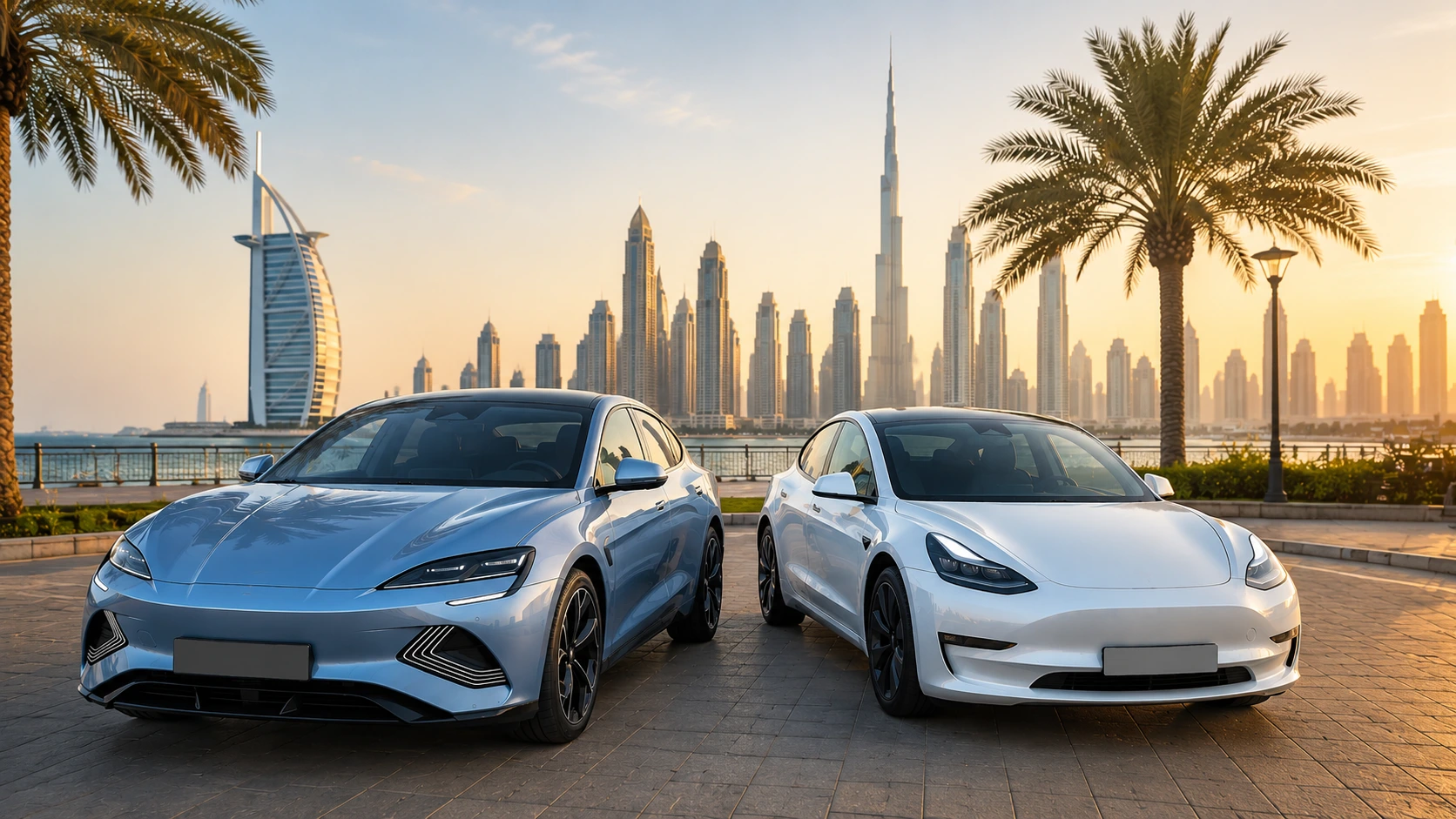
Quick summary: EV insurance in the UAE costs AED 2,800–9,000 per year for comprehensive cover, roughly 10–30% more than a comparable petrol car. The gap comes down to battery replacement costs (AED 50,000–100,000), a limited pool of specialist repairers, and upgraded flood coverage after the April 2024 rains. Third-party liability, which UAE law requires, starts at AED 450. This guide covers what's included, what it costs, and what actually reduces your premium.
Is electric vehicle insurance mandatory in the UAE?
Yes. UAE Federal Law requires all vehicles on UAE roads, including electric vehicles, to carry at minimum a third-party liability (TPL) policy. The Central Bank of the UAE regulates all insurance brokers, including Shory (Licence No. 287), and enforces this requirement. Driving uninsured is a traffic offence with fines and possible vehicle impoundment.
TPL for an EV in the UAE costs AED 450–1,000 per year, covering bodily injury and property damage caused to other people in an accident. Most EV owners go with comprehensive cover, which also protects the vehicle itself. That matters more for an EV than a petrol car: a battery replacement alone can run AED 50,000–100,000.
What does electric vehicle insurance cover?
EV insurance in the UAE uses the same two-tier structure as conventional car insurance, but good EV policies include cover that standard motor policies often leave out.
Comprehensive cover
Comprehensive EV insurance covers accidental damage, theft, fire, natural disasters including floods, and vandalism, plus your own injuries and those of your passengers. Beyond that standard scope, watch for these EV-specific additions:
Battery damage. Lithium-ion battery packs are the most expensive part of any EV. Replacement costs run AED 50,000–100,000 depending on the model. Standard motor policies exclude battery replacement. A proper EV comprehensive policy covers battery damage from collision, fire, or flood, though not from normal capacity degradation over time.
Home and public charging equipment. Some policies cover damage to your home wall box or incidents at DEWA Green Charger stations. This is not standard everywhere, so check before you buy.
EV roadside assistance. A flat battery is not the same as a flat tyre. EV-specific breakdown services will tow you to a charging station, not a garage. Standard roadside assistance packages often can't help.
Flood cover for EV systems. After the April 2024 UAE rains caused AED 9.175 billion in total insurer losses, several providers added enhanced flood cover for EV high-voltage systems and battery packs. Lithium-ion batteries exposed to standing water can fail days later, which makes EV flood claims more complicated and expensive than typical water damage.
Third-party liability cover
The legal minimum. Covers bodily injury and property damage to other people. Does not cover damage to your own vehicle, battery, or charging equipment.
How much does EV insurance cost in the UAE?
EV insurance in the UAE costs 10–30% more than an equivalent petrol car policy. The table below gives indicative ranges for 2025–2026.
| Coverage type | EV (Comprehensive) | ICE car (Comprehensive) | EV (Third party) |
| Budget segment (e.g., MG ZS EV) | AED 2,800–4,500 | AED 1,200–2,500 | AED 450–650 |
| Mid-range (e.g., Tesla Model 3) | AED 4,500–7,000 | AED 2,500–4,500 | AED 650–900 |
| Premium (e.g., Porsche Taycan, Mercedes EQS) | AED 7,000–9,000+ | AED 4,500–8,000 | AED 900–1,000 |
Premiums vary by vehicle age, driver age, claims history, and insurer. Figures above are indicative ranges based on market data.
Khaleej Times reported a 3% general increase in UAE motor premiums in 2025, with accident-intensive EV claims adding a further 15% uplift in some segments. As EV sales grow, premiums should ease somewhat. UAE EV registrations rose from 232 in 2019 to 4,461 in 2023, and more vehicles on the road means more repairers competing for the work.
Why is EV insurance more expensive?
The battery is the main reason. A lithium-ion pack for a Tesla Model Y costs AED 60,000–90,000 to replace. Even a partial swap runs AED 25,000–40,000. Insurers build that exposure into the premium from day one.
The second factor is repair availability. The UAE has a growing network of authorised EV workshops, but it's still limited compared to conventional garages, so repair costs stay high.
The third is flood risk. After April 2024, insurers took a harder look at EV-specific water damage exposure. High-voltage battery systems can sustain damage that doesn't show up until days after submersion, which makes these claims slow and expensive to settle.
EV ownership costs in the UAE
The insurance premium is higher, but EV ownership saves money elsewhere — and the gap is significant.
DEWA charges AED 0.29/kWh at its 382 public Green Charger stations across Dubai (as at 2025). A Tesla Model 3 with a 50 kWh battery costs about AED 14.50 to charge from empty, enough for 400–500 km. A Toyota Camry covering the same distance burns roughly 40 litres of petrol at AED 2.35/L (ENOC/ADNOC April 2025 price), costing about AED 94. That's an 85% saving per trip.
Across a year of 20,000 km driving, the numbers add up:
- Fuel savings: AED 3,000–6,000
- Maintenance savings: AED 1,500–3,000 (no oil changes, regenerative braking reduces brake wear, fewer moving parts overall)
- Salik tolls: Standard rates apply. The EV exemption ended in 2018. AED 4 off-peak, AED 6 peak, free between 1am and 6am. Heavy commuters crossing multiple gates may add AED 500–1,000 per year.
- Net saving vs. petrol: AED 4,000–8,000 per year, before accounting for the insurance premium difference.
The Dubai government also waives vehicle registration fees for EVs (AED 400–600 per year), offers free or subsidised parking in many Dubai and Abu Dhabi zones, and DEWA's free public charging programme remains available for registered users, though terms are reviewed annually. The broader context: Dubai's target is 42,000 EVs on its roads by 2030.
Most popular EVs in the UAE and what they cost to insure
Tesla Model 3 / Model Y are the most common EVs in the UAE. Comprehensive insurance runs AED 4,500–7,000. Tesla's over-the-air software updates resolve some issues without a workshop visit, which tends to reduce minor claim frequency.
MG ZS EV is the most affordable starting point (from AED 125,000). Insurance follows suit at AED 2,800–4,500 comprehensive, since the vehicle value and battery size are both smaller.
BYD Atto 3 / BYD Seal have a growing share of UAE registrations. Comprehensive insurance is broadly similar to MG pricing as parts availability improves.
Kia EV9 is a 7-seat family EV at AED 250,000+. The higher vehicle value pushes premiums into the mid-range.
Porsche Taycan / Mercedes EQS / BMW iX sit at the top of the market and the top of the premium range (AED 7,000–9,000+).
One thing worth confirming regardless of model: does your insurer have an authorised repair arrangement for your specific brand? Tesla requires OEM parts and approved body shops, and not all UAE insurers cover those costs as standard.
What affects your EV insurance premium
Vehicle value is the biggest variable. A Porsche Taycan at AED 400,000 costs substantially more to insure than an MG ZS EV at AED 125,000.
Battery age and condition matter to some insurers. Certain providers apply loadings or exclusions to batteries below a stated state of health (SOH) or above a certain age. Read the policy wording on this before buying.
Driver age and claims history work the same as with any motor policy. Younger drivers and those with recent claims pay more. A UAE no-claims discount (NCD) of up to 20% is available from most providers after a clean year.
Telematics can reduce premiums 10–15%. Most modern EVs already collect driving data; ask your broker whether your car's data qualifies for a discount before installing a separate device.
Overnight parking location makes a small difference. A covered garage reduces theft and weather-damage risk in the insurer's model.
Geographic scope is worth considering. UAE-only policies are cheaper than GCC-wide cover. If you don't regularly drive to Oman or Saudi Arabia, there's no reason to pay for coverage you won't use.
How to reduce your EV insurance premium
Rates for the same EV and driver profile can vary 30–40% between insurers in the UAE. That's a large enough gap to make comparison worthwhile. Using a licensed broker like Shory means you get quotes from multiple insurers in one go rather than submitting separate applications to each.
A higher voluntary excess lowers your annual premium. Set it at a level you can actually afford to pay if you need to claim — otherwise it defeats the purpose.
Named driver policies are cheaper than open policies. If the car will only ever be driven by one or two people, don't pay for anyone-can-drive cover.
Ask specifically about EV discounts. Some UAE insurers offer eco-vehicle pricing or loyalty pricing for EV owners. These aren't always listed on the quote summary, so ask your broker to check.
Review your add-ons. Rental car cover, personal belongings cover, and agency repair endorsements all have a cost. Some are worth it; many aren't used. Go through each one.
Small claims can cost you more in the long run. A parking scuff worth AED 800 may be cheaper to repair out of pocket than to claim and lose a year of NCD. A multi-year NCD reduces future premiums by more than the value of most minor claims.
Getting an EV insurance quote with Shory
Shory is authorised and regulated by the Central Bank of the UAE (Licence No. 287). As an insurance broker, Shory compares policies from multiple licensed UAE insurers, so you're seeing competitive pricing without filling in the same form eight times.
To get a quote, you'll need:
- Your vehicle registration card (Mulkiya)
- Your UAE driving licence
- The current market value of your vehicle (the system can estimate this)
- Your claims history for the past 1–3 years


