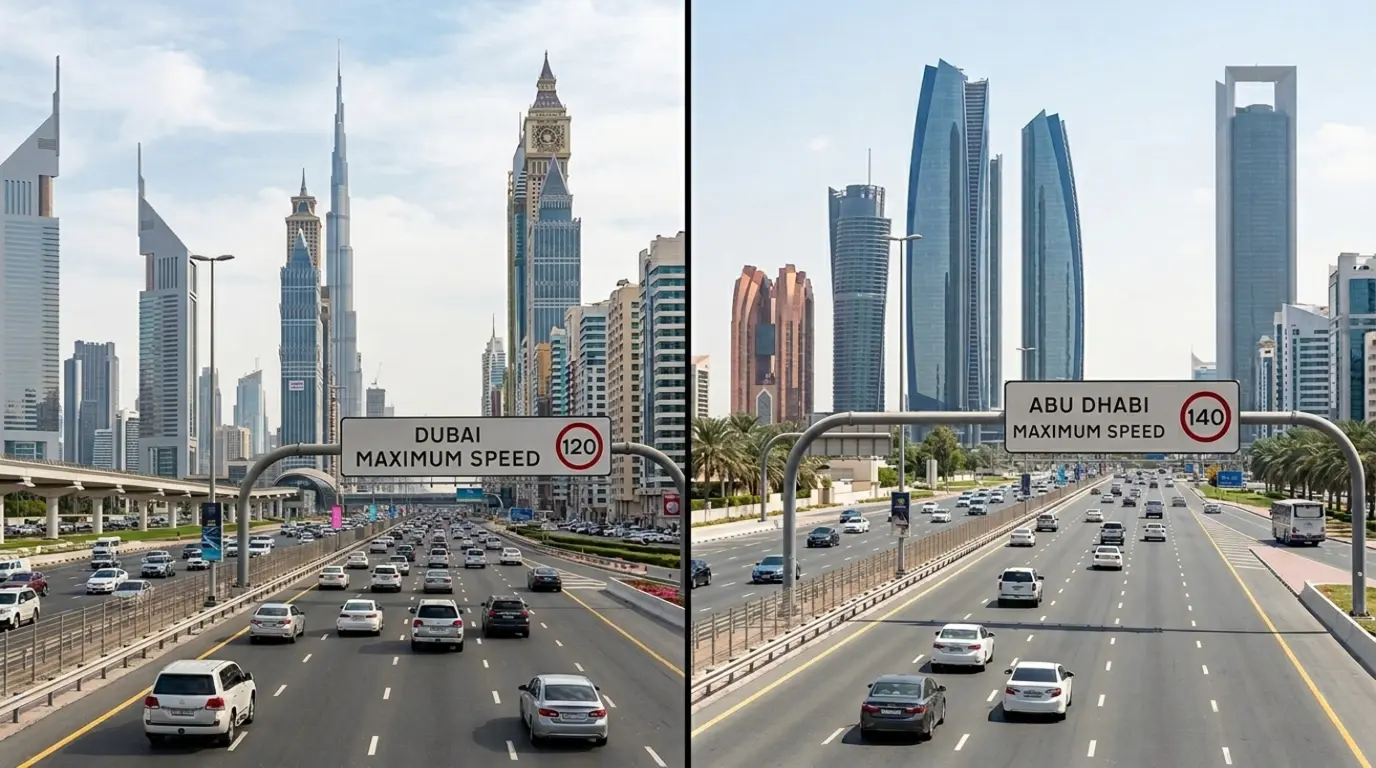
Understanding traffic laws in UAE becomes critical once you realize that Dubai's 20 km/h speed buffer can vanish the moment you cross into Abu Dhabi. Both emirates fall under federal traffic legislation, but their enforcement approaches differ by a lot. Dubai allows drivers a 20 km/h tolerance over posted limits. Abu Dhabi removed its speed buffer in 2018. This catches many visitors off guard with fines ranging from AED 300 to AED 600. We've created this piece to break down the key differences you need to know. We'll cover everything that sets Dubai apart from Abu Dhabi, from abu dhabi traffic fine rules and black points to parking systems and toll gates. You can drive through both emirates with confidence and avoid unexpected penalties.
Speed Limits and Radar Enforcement: Dubai's Buffer vs Abu Dhabi's Zero Tolerance
Dubai's 20 km/h Speed Buffer System
Speed enforcement in Dubai follows a buffer approach that most emirates in the UAE adopt. Radars trigger only when you exceed the posted limit by more than 20 km/h. A road marked 100 km/h will activate the camera at 121 km/h. This tolerance applies to Sheik Zayed Road, Al Khail Road and other major highways where limits range from 100 to 120 km/h.
The system relies on Doppler radar technology. The device sends constant radio waves at a fixed frequency, and moving vehicles reflect these waves back. The frequency shift caused by your speed allows the camera's computer to calculate whether you've crossed the threshold. High-resolution cameras capture your license plate, location, time and recorded speed once triggered.
Abu Dhabi's Strict Zero-Tolerance Policy
Abu Dhabi removed its speed buffer in 2018. The posted limit is the enforceable maximum. A sign that displays 120 km/h means exceeding it by even 1 km/h can result in a fine. This strict approach applies to all Abu Dhabi roads.
Speed enforcement here uses fixed radars, mobile cameras and overhead monitoring systems. Abu Dhabi Police manage over 250,000 vehicles through smart systems that provide constant data. AI-powered cameras identify seatbelt and mobile phone violations besides speed detection, and they analyze high-resolution images through automated processes.
Common Speed Limit Mistakes When Crossing Emirates
Drivers accustomed to Dubai's buffer often accumulate fines when entering Abu Dhabi. They don't realize the enforcement rules have changed. GPS devices may not always alert you to the policy shift. Checking electronic boards for posted limits becomes critical at emirate borders.
Smart Radar Systems: How Each Emirate Monitors Speeds
Abu Dhabi's Safe City project, launched four years ago, uses AI to analyze data from cameras and radars across the emirate. The system detects sudden lane changes at traffic signals and issues fines via SMS within 48 hours. Dubai's network focuses on high-traffic zones and freeways, where violations can result in penalties up to AED 3,000, black points and vehicle impoundment.
Traffic Fines Comparison: Dubai vs Abu Dhabi Fine Structures
Running Red Lights: AED 1,000 Fine in Both Emirates
Red light violations carry similar penalties across Dubai and Abu Dhabi. Light vehicles face an AED 1,000 fine, 12 black points, and 30 days of vehicle impoundment. Heavy vehicles including trucks and busses incur steeper consequences: AED 3,000, 24 black points resulting in immediate license suspension, and 60 days impoundment. Smart intersection cameras in Dubai detect violations on their own. Abu Dhabi uses infrared technology that monitors multiple lanes at once without visible flash.
Speeding Fines: How Penalties Scale with Speed
Speeding penalties scale based on how far you exceed the limit. Exceeding by up to 20 km/h costs AED 300 with zero black points. Beyond that, fines increase: 21-30 km/h over brings AED 600, while 31-40 km/h costs AED 700. Exceeding by 41-50 km/h results in AED 1,000 and 6 black points. Above 60 km/h, penalties include AED 2,000, 12 black points, and 30 days impoundment. Exceeding by more than 80 km/h triggers AED 3,000, 23 black points, and 60 days impoundment.
Phone Usage While Driving: AED 800 vs AED 800
Federal traffic law sets mobile phone usage penalties at AED 800 and 4 black points. This applies whether you hold the phone to call, text, check social media, or take photos. Dubai implemented vehicle impoundment for 30 days starting October 2024.
Reckless Driving and Vehicle Impoundment Rules
Reckless driving carries an AED 2,000 fine, 23 black points, and 60 days vehicle impoundment. Dubai impounds vehicles when accumulated fines exceed AED 6,000. Repeat impoundment within one year doubles both the impoundment period and release fees.
Abu Dhabi Traffic Fine Rules and Payment Systems
Abu Dhabi offers multiple payment channels: TAMM platform, Abu Dhabi Police app and website, Ministry of Interior app, and Emirates Vehicle Gate. All pending fines must be cleared before vehicle registration renewal.
Conclusion
The Dubai vs Abu Dhabi traffic law debate centers on one critical difference: speed enforcement. Dubai's 20 km/h buffer gives you breathing room. Abu Dhabi's zero-tolerance policy doesn't. If you drive between both emirates often, check posted speed limits at the time you cross borders and assume the strict limit applies unless you're certain otherwise.
Download both emirates' traffic apps for fine notifications. Your speedometer accuracy could save you hundreds of dirhams in unexpected fines.
Key Takeaways
Understanding the critical differences between Dubai and Abu Dhabi traffic enforcement can save you from costly fines and license suspension when driving between emirates.
- Dubai allows 20 km/h over posted speed limits before fines trigger, while Abu Dhabi enforces zero tolerance with immediate penalties for any speed violation
- Red light violations cost AED 1,000 with 12 black points in both emirates, but phone usage while driving now includes 30-day vehicle impoundment in Dubai
- Accumulating 24 black points results in automatic license suspension, making speed buffer awareness crucial when crossing emirate borders
- Both emirates use AI-powered smart cameras that detect multiple violations simultaneously, issuing fines via SMS within 48 hours of detection
- Always check posted speed limits at emirate borders and assume strict enforcement applies unless you're certain of local buffer policies
The key to safe driving across UAE emirates is treating each jurisdiction's speed limits as absolute maximums, regardless of any tolerance you might expect from your home emirate.