


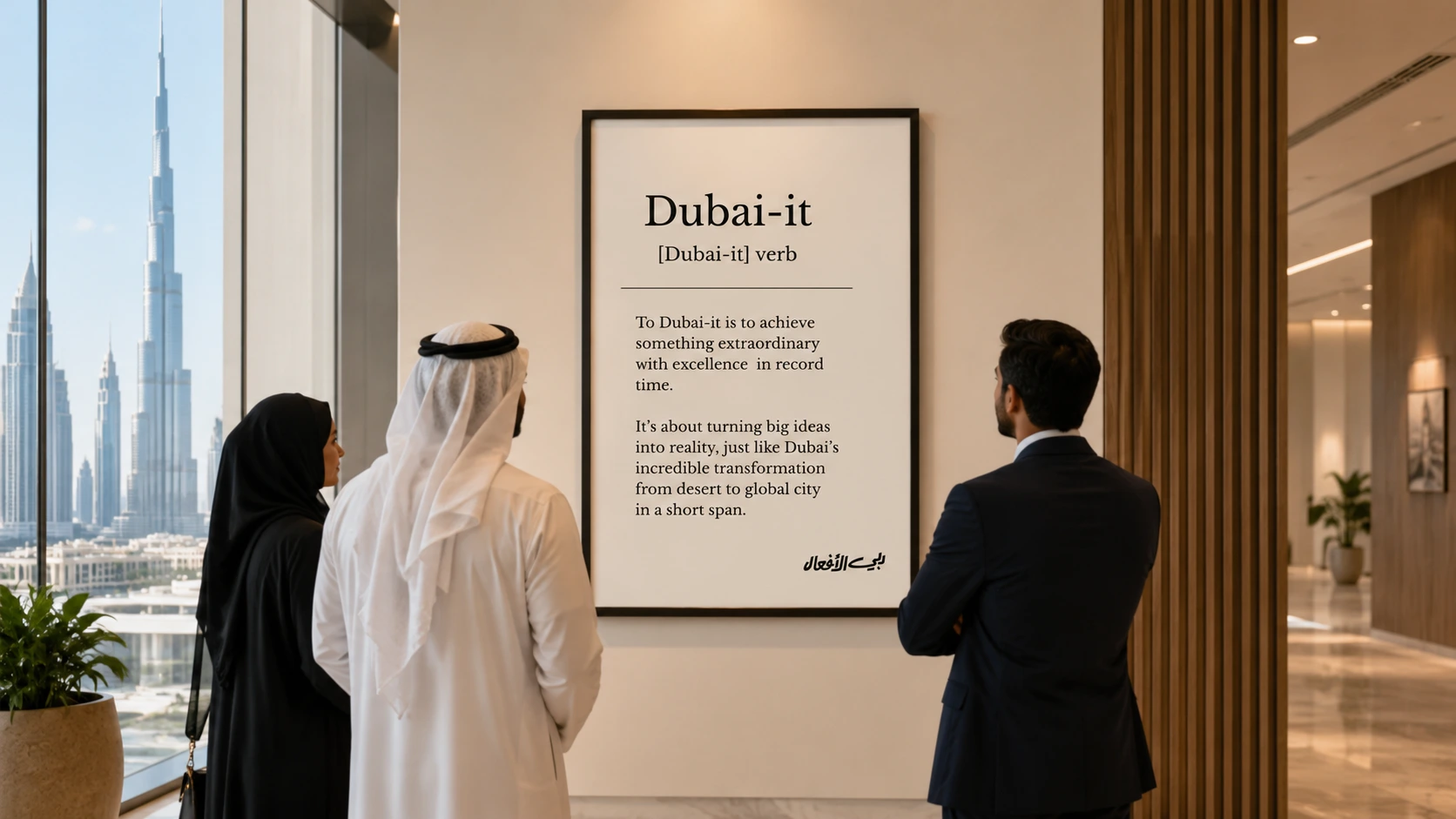
"Dubai-it" is defined as achieving something extraordinary with excellence in record time. The term captures how Dubai went from a trading creek town of 60,000 people in the 1960s to one of the world's busiest cities — and Sheikh Mohammed bin Rashid Al Maktoum formalized that approach into a transferable philosophy in June 2026.
Sheikh Mohammed launches Dubai-it as an official work philosophy
His Highness Sheikh Mohammed bin Rashid Al Maktoum, Vice President and Prime Minister of the UAE and Ruler of Dubai, announced the Dubai-it initiative on X, framing it as an attempt to codify Dubai's work culture and carry it forward into the next generation of government institutions, companies, and leaders.
The initiative is not just internal. Dubai intends to make the methodology exportable — a framework other cities and organizations can actually apply, not just admire.
What did the helicopter video show?
Sheikh Mohammed's announcement came with two clips of him surveying Dubai from a helicopter, filmed decades apart. The first: empty desert. The second: Burj Khalifa, Palm Jumeirah, a skyline. The gap between those two images is the argument for Dubai-it better than any press release could make it.
What does Dubai-it mean?
Sheikh Mohammed defined it directly: "To achieve something extraordinary with excellence in record time. It's about turning big ideas into reality, just like Dubai's incredible transformation from desert to global city in a short span."
Two principles sit underneath that definition. Speed does not mean haste. Quality does not mean slowness. And running through both, the accountability line Sheikh Mohammed posted directly on X:
"We say what we do… and we do what we say." — His Highness Sheikh Mohammed bin Rashid Al Maktoum (@HHShkMohd), June 2026
That is not a new phrase for Dubai. It has been his governing principle for decades. What Dubai-it does is formalize it — turn it from a leadership motto into an institutional standard that every government body and company in the emirate is expected to live by.
Why did Dubai earn the right to become a verb?
There is a short list of places that have become verbs. Google it. Uber it. The bar is high: you need a record people can actually point to.
Dubai's case is concrete. In the 1960s, it was a small trading post with almost no infrastructure. What followed was not slow, incremental progress — it was a succession of projects that weren't supposed to be possible, delivered on the declared timeline.
That record is why the philosophy has weight. Without it, Dubai-it would just be a branding exercise.
What are the four principles of the Dubai-it philosophy?
Sheikh Mohammed outlined four specific pillars. They are not abstract values — each one is a direct response to how organizations actually fail to deliver.
Speed without haste
Speed does not mean haste, and that distinction matters more than it sounds.
Most organizations that try to move fast end up moving recklessly — making calls before they have enough information, cutting corners that cost more time later. Dubai's approach is different. Rapid execution requires deliberate planning and decisive action on decisions that can be reversed if they go wrong.
The Metro was not built fast because corners were cut. It was built fast because the planning was serious and the decision-making was clean. Many of the choices inside a fast-moving project are reversible. Recognizing that removes a lot of the hesitation that slows things down. When you know you can course-correct, you spend less time debating whether to move.
For any organization applying this principle, the question is not "how do we go faster?" It is "where are we slowing ourselves down without a good reason?"
That reframe tends to be more productive. The answer is usually not more urgency — it is fewer unnecessary approvals, clearer ownership, and decisions that get made rather than deferred.
Quality without slowness
Quality does not mean slowness. Most teams treat thoroughness and speed as a tradeoff — pick one, give up the other.
Dubai's construction record challenges that assumption directly. The Burj Khalifa was built in roughly five and a half years, including through a global recession. The Palm Jumeirah was ready for residents within six years of breaking ground. Neither was a rush job in the sense of being sloppy or incomplete.
The difference is clarity about standards. When a team knows in advance which requirements are non-negotiable and which decisions can be made quickly, the work moves faster without getting worse. Mediocrity is not the price of speed — it is usually the result of unclear priorities and decisions made under pressure.
This principle asks organizations to define their standards explicitly before the project starts, so those calls are not being made mid-delivery. When that happens, quality and pace end up reinforcing each other rather than competing.
Ambition paired with execution
Ambition has no value without execution. That is not a motivational line — it is a practical observation.
Bold visions are common. Organizations that actually deliver on them are not. The Dubai-it model treats the gap between vision and delivery as the main problem to solve. The goal is not better ideas. It is building systems and habits that turn ideas into finished things.
What this looks like in practice: decisions get made, not deferred. Accountability is real, not aspirational. The benchmark for "done" is something the world can see — not something that looks good in an internal progress report.
Sheikh Mohammed's phrase for this is direct: "The future is not something to wait for but something to build." That shifts organizations from planning mode into delivery mode, which is where most plans actually fail — not in the planning itself, but in the transition to doing.
"We say what we do, and we do what we say"
His Highness Sheikh Mohammed bin Rashid Al Maktoum wrote it plainly on X when he launched Dubai-it: "We say what we do… and we do what we say." Simple to state. Hard to actually live by. Most organizations have a version of it somewhere in their values document. Fewer have a track record that matches it.
The phrase carries weight here because the history backs it up. When he announced Palm Jumeirah, plenty of people doubted it would happen. When he announced the Metro, critics said a car city would never adopt it. When Expo 2020 was hit by a global pandemic, the expectation was that it would be scaled back. None of those predictions proved correct.
That consistency is what makes the phrase credible rather than decorative. Accountability at the top creates pressure throughout the organization. When the leadership keeps its word, every layer is expected to keep theirs. And when a commitment is made publicly — as Dubai's major projects have been — backing down is simply not the option on the table.
What landmark projects prove Dubai-it works?
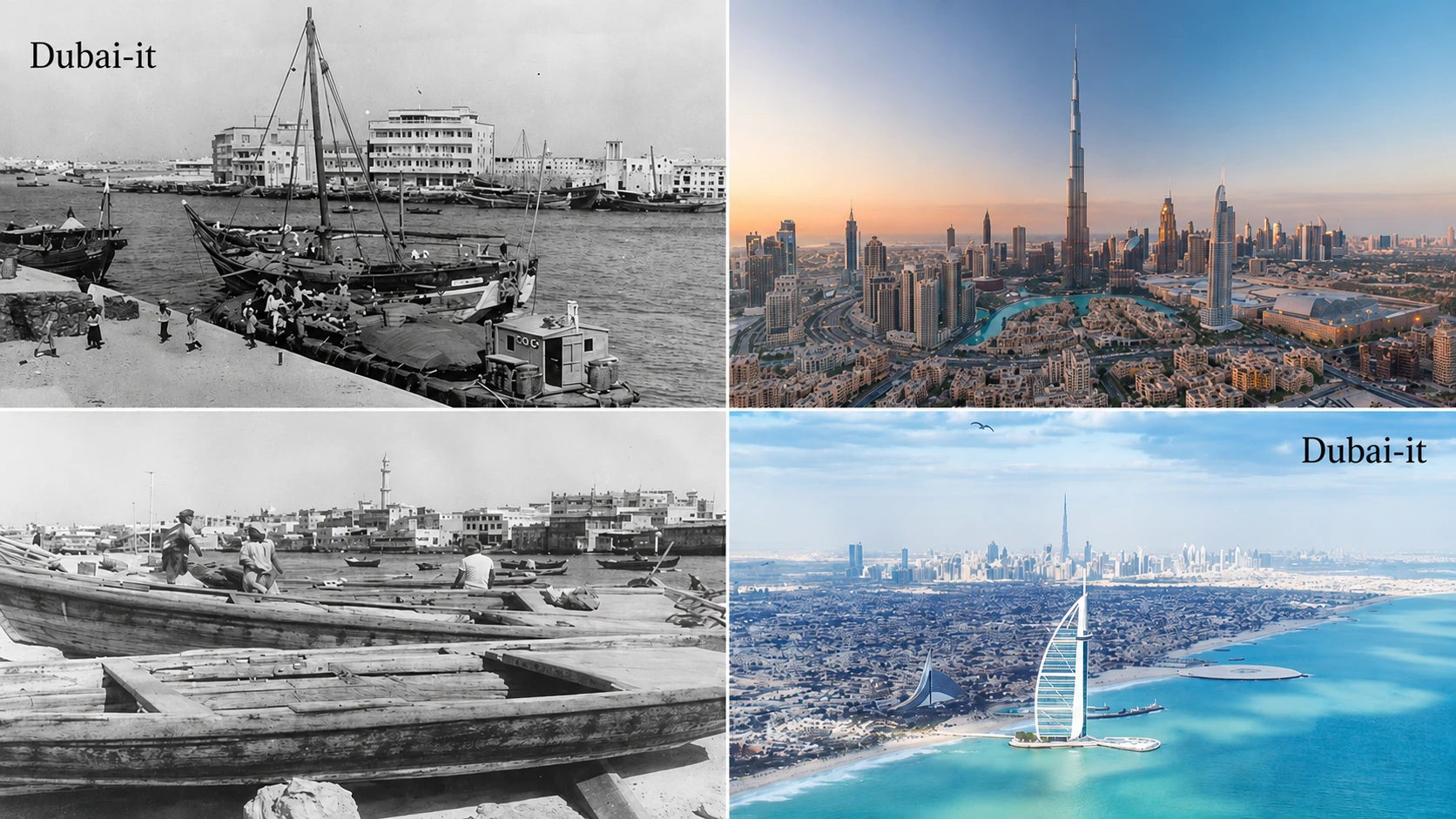
Image source: Daily Mail
Five projects. Each one delivered at a pace that made other cities pay attention. Each one hit a point where stopping would have been understandable. None of them stopped.
Dubai International Airport: from sand runway to world's busiest hub
Dubai International Airport opened on September 30, 1960, with an 1,800-meter compacted-sand runway built for aircraft no larger than a DC-3. In 2025, the same airport handled 95.2 million passengers, retaining its position as the world's busiest international hub. In 1969, nine airlines flew to 20 destinations. By 2025, 108 carriers connected 291 cities across 110 countries. That shift happened within one working lifetime.
Al Maktoum International Airport, currently under construction, is planned to handle 260 million passengers annually when complete — making it the largest aviation hub in the world.
Palm Jumeirah: building an island that didn't exist
Construction started in June 2001. Workers moved 110 million cubic meters of sand, extending the structure five kilometers into the Arabian Gulf with no precedent to copy from. The first residents arrived in October 2007 — six years from breaking ground to occupation. The timeline held despite engineering challenges that had never been solved before.
Today, the Palm Jumeirah is one of Dubai's most sought-after addresses and one of the most recognized man-made structures on earth.
Burj Khalifa: finishing the world's tallest building through a recession
Construction started in September 2004. In 2008, a global financial crisis hit and Dubai's property prices dropped 48%. Most comparable developments paused or collapsed entirely. Burj Khalifa kept going. It opened on January 4, 2010, at 828 meters — still the world's tallest building. The decision to continue through the crash was not just symbolic. It was what the philosophy required.
Dubai Metro: changing how a car city moves
The Metro launched on September 9, 2009. At the time, public transport accounted for only 6% of how residents moved around the city. By 2010, the Metro had carried 39 million riders. By 2012, 109 million. By 2023, public transport's share of resident movement had reached 20.9%.
Changing the transit habits of a city built entirely around cars, in a region where cars are the default, is genuinely difficult. Dubai managed it in under fifteen years.
Museum of the Future: built for 2071
The Museum of the Future opened February 22, 2022. The torus-shaped structure has no columns — the load runs through a perforated steel facade inscribed with Arabic calligraphy from Sheikh Mohammed's own writings. Inside, the exhibits are set in 2071. The museum does not display history or the present. It builds a version of the future and invites visitors to walk through it.
How is Dubai embedding and exporting the Dubai-it methodology?
The initiative will be rolled out across government institutions and companies in Dubai. The Dubai Economic Leadership Program and the UAE Leadership 2.0 Program are both being updated to include Dubai-it principles, creating a pipeline of leaders trained in execution-focused governance from the start of their careers.
The wider goal is export. University partnerships will incorporate the methodology into MBA and executive education curricula, making a structured version of Dubai's approach available to leaders globally — not as inspiration, but as a replicable framework.
Conclusion
Dubai's transformation from a desert trading post into the world's busiest airport hub, a city built on a man-made island, and the home of the tallest building in the world is documented history. Dubai-it puts a name on the approach behind that transformation and makes the framework available to anyone willing to use it.
Move fast, maintain standards, deliver what you said you would. Most organizations manage one or two of those. Dubai's record is that it has managed all three, repeatedly, at a scale that is difficult to dismiss.
Key takeaways
- Dubai-it is defined as achieving extraordinary results with excellence in record time — not by treating speed and quality as a tradeoff, but by running them together.
- The philosophy has four principles: speed without haste, quality without slowness, ambition paired with execution, and "we say what we do, and we do what we say."
- Dubai's track record backs the claim: from a 60,000-person trading town in the 1960s to the world's busiest international airport by 2025, handling 95.2 million passengers.
- The initiative is being embedded across Dubai's government institutions and leadership programs, with the explicit goal of making the methodology globally available.
- The initiative represents a documented execution model — backed by Palm Jumeirah (110 million cubic meters of sand relocated), Burj Khalifa (completed through a 48% property price crash), and Dubai Metro (public transport share raised from 6% to 20.9%) — not just a brand campaign.


